
buddyfix — User Guide (en)

buddyfix
user guide
1. Symbol explanation
The signal word indicates a potentially dangerous situation. If this situation is not avoided, it can lead to serious injury or even death.
The signal word indicates a potentially hazardous situation which, if not avoided, could result in damage to the product or other property.
2. Certification
Certification: UN R 129/03 specific vehicle booster seat
Product name: buddyfix
Size suitability: 100-150cm
Age: from approx. 3.5 years until 12 years
Thank you for choosing a product from Moin Spatz Products.
3. Safety
IMPORTANT: This instruction manual is an integral part of the product and contributes to safe use. Read the instruction manual carefully before installing the child seat in your vehicle.
Failure to follow the manufacturer's instructions can result in serious injury or death. To ensure your child's proper protection, it is essential to use the child car seat exactly as described in these instructions.
Risk of injury due to modification
The approval certification and any warranty are void as soon as you modify this product.
- Do not modify this product, its components, or accessories.
- Do not use the product if it has been modified.
- The stickers on the product are an integral part of the product. Do not remove the stickers.
- This child car seat is approved according to UN R129/03.
- The child car seat is approved for forward-facing use for children between 100cm and 150cm tall.
- Only a correctly adjusted headrest provides the greatest possible protection and comfort for your child and also ensures optimal positioning of the diagonal belt.
- This child car seat may only be installed on vehicle seats that are approved for the use of child restraint systems according to the vehicle's handbook.
- Only suitable for vehicle seats with a three-point automatic seat belt that are approved according to UN Regulation No. 16 or an equivalent standard.
- The three-point seat belt must run through the designated belt guides. The belt routing is described in detail in this handbook and is also marked in green on the child car seat.
- The three-point seat belt must only run through the designated, green-marked guides. The belt routing is described in detail in this handbook.
- Never secure the product with a two-point seat belt.
- Do not use the child car seat for longer than 9 years. Child car seats are subject to high stress during their product lifespan, which can lead to deterioration of the material over time.
Risk of injury due to damaged product
In the event of an accident, this product may be damaged without the damage being immediately apparent. A subsequent accident could result in serious injury.
- Never use a damaged product.
- Replace the product after an accident.
- The product may be damaged by improper handling (e.g., if dropped).
- Regularly inspect the product for damage and ensure it is fully functional.
Danger of burns from hot components.
Components of the child car seat can heat up due to sunlight. Children are sensitive and can be injured as a result.
- Protect the product from intense, direct sunlight while it is in use.
Danger to life from exposure to heat or cold.
If children are exposed to prolonged high temperatures or cold, there is a risk of injury or even death.
- Never leave children unattended in a vehicle.
Risk of injury when getting in and out of the vehicle
It can be dangerous to be outside the vehicle on the street side.
- If possible, let children get in and out of the vehicle on the sidewalk side.
- Secure and remove the child car seat from the sidewalk side.
Crush hazard due to movable backrest.
When the backrest is raised, fingers can be crushed between the backrest and the seat cushion.
- Keep body parts away.
Risk of injury from unsecured objects
In the event of braking or an accident, unsecured objects, people, and animals can injure other passengers within the vehicle.
- Secure the product as described in these operating instructions.
- Lock the vehicle seat backrests (e.g. lock the rear seats).
- Secure or remove all heavy or sharp-edged objects from the vehicle.
- Ensure that the product is always secured in the vehicle, even when no child is being transported.
Regularly check all plastic and metal parts of the child car seat for damage or changes in shape or color. If you notice any changes, the child car seat must be inspected.
Risk of injury due to incorrect seat belt routing
If the diagonal belt points in the wrong direction or is twisted, safety is negatively affected.
- Check the belt routing.
- Make sure the diagonal belt points towards the vehicle seat.
- Do not use the child seat if the diagonal belt points in the wrong direction.
- Make sure the diagonal belt is not twisted.
- Make sure the diagonal belt is in the belt guide.
Risk of injury due to improper belt routing
The position of the vehicle's seat belt buckle affects the safety of the child seat. The vehicle's seat belt buckle must never extend beyond the green belt guides on the child seat. If the vehicle's seat belt buckle is located in or in front of the green belt guide, the child seat is not approved for use in this position in the vehicle.
- Do not use this product as a toy.
- Do not use this product as a seat outside the vehicle.
- Ensure that the product is not wedged between hard objects (car door, seat rails, etc.).
- Keep the product away from moisture, wetness, dust, and salt.
- Do not place heavy objects on the product.
- Never lubricate or oil any part of the product.
- Delicate seat covers in your vehicle may be damaged (pressure marks, tears, color transfer, etc.). To avoid this, use a seat protector or child car seat mat.
4. Seat components
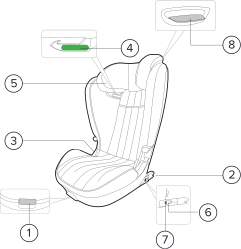
- ISOFIX arms adjustment button
- ISOFIX locking arms
- Lap belt guides
- Shoulder belt guides
- Headrest
- ISOFIX release button
- ISOFIX indicator
- Headrest adjustment button
5. Choosing the correct position in the vehicle
Risk of injury from front airbag.
Airbags are designed to restrain adults. If the child seat is too close to the front airbag, minor to serious injuries can result in an accident. If the child seat is secured in the front passenger seat, slide the passenger seat back as far as possible.
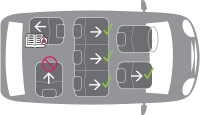
This is a specific vehicle booster seat for older children. With retracted ISOFIX locking arms (2) the car seat can be used on vehicle seats which are equipped with an automatic three point belt. For use with ISOFIX, please refer to the list of compatible vehicles. The most up to date version can be found at:
https://docs.moin-spatz.com/buddyfix-compatibility
The car seat can generally be installed on any vehicle seat with retracted ISOFIX connectors using the vehicle's three-point seat belt. However, as limitations may apply, you should check our vehicle compatibility list. If your vehicle is not listed, please contact us at hello@moin-spatz.com.
For children taller than 135 cm, compatibility of the car seat with the vehicle may be limited. Use the compatibility list to ensure the car seat can be used without restrictions in all headrest positions.
Some vehicles are equipped with rear-facing car seats. This product may be used in a rear-facing car seat if it is approved for the transport of adults. Refer to your vehicle's owner's manual for details.
6. Installing the car seat in the vehicle (with ISOFIX)
Using ISOFIX creates a connection to the vehicle, improving the connection to the car seat and the stability of the seat. Your child must still be secured with the vehicle's three-point seat belt.
Ensure the vehicle seat backrest is in an upright position and locked in place.
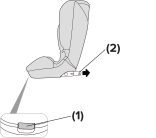
- Press the adjustment button (1) and fully extend the ISOFIX arms (2).
- Place the child seat on the corresponding vehicle seat in the car.
- Slide the two ISOFIX locking arms (2) into the ISOFIX anchor points on the vehicle seat until they click audibly into place.
- Press the adjustment button (1) and slide the child seat against the vehicle seat until it is firmly and completely flush against the seat.
- Verify that the child seat is securely installed by attempting to pull it out of the ISOFIX anchor points. The green ISOFIX safety indicator on both ISOFIX locking arms must be clearly visible.
If the vehicle's headrest is obstructing the child seat, pull it out or remove it completely (except on rear-facing vehicle seats).
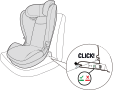

The backrest of the child seat must be in contact with the vehicle backrest.
7. Installing the car seat in the vehicle (without ISOFIX)
Ensure the vehicle seat backrest is in an upright position and locked in place.
- Make sure the ISOFIX locking arms are fully retracted. If necessary, press the adjustment button (1) and fully retract the ISOFIX arms (2).
- Place the child seat on the corresponding vehicle seat in the car.
- Slide the child seat against the vehicle seat until it is firmly and completely flush against the seat.
If the vehicle's headrest is obstructing the view, pull it out or remove it completely (except on rear-facing vehicle seats).
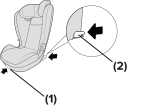


8. Removing the child seat from the vehicle
Perform the installation steps in reverse order.
- Unlock the ISOFIX connectors (2) on both sides by pressing the ISOFIX release buttons (6).
- Press the ISOFIX connector adjustment button (1) and slide the ISOFIX connectors (2) back into the seat.
- Remove the child seat.
9. Adjustment of the headrest
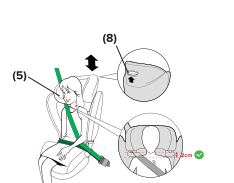
The height-adjustable headrest (5) can be adjusted by pulling upwards the headrest adjustment button (8) located on the back of the headrest.
Adjust the headrest so that the distance between the child's shoulders and the headrest is no more than 2 cm.
10. Securing the child
Risk of injury due to loose seat belts and belt slack.
Belt slack refers to parts of the vehicle seat belt that lie loosely against the child's body. Belt slack negatively impairs the protective function.
- Ensure that the seat belts are taut and not twisted.
- Avoid the child wearing thick clothing under the seat belt.
Risk of injury to the abdomen.
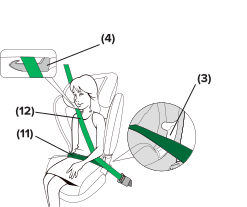
- Ensure that the lap belt (11) runs as low as possible over the child's groin on both sides. This is the only way the lap belt can function optimally in the event of an accident.
- Ensure that the lap belt is not twisted.
Risk of injury.
Ensure that the diagonal strap runs over the child's collarbone and does not rest against their neck. If necessary, adjust the strap position by adjusting the headrest.
- Have the child sit in the child seat.
- Guide the vehicle seat belt around your child and insert the belt tongue (9) into the vehicle's seat belt buckle (10) until it clicks audibly into place.
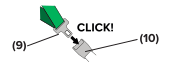
- Place the lap belt in the green-marked lap belt guides (3) of the child seat.
- Tighten the lap belt.
- Ensure that on the buckle side, the lap belt (11) and shoulder belt (12) are inserted together in the lap belt guide (3).
- Guide the diagonal belt (12) through the green shoulder belt guide (4) on the headrest.
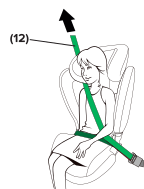
- Tighten the vehicle seat belt by pulling the diagonal belt (12) upwards.
11. Adjusting the child seat
The child seat should be adjusted before the child is placed in it.
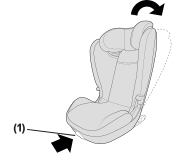
This child car seat offers the option of adjusting the seating position. To use this feature, the seat must be installed in the vehicle using ISOFIX.
To adjust the seating position, press the adjustment button (1) on the front of the underside of the seat cushion and pull the seat forward or slide it back as desired.
12. Cleaning the child car seat
The cover is an integral part of the child car seat and contributes to its safety. Therefore, the child car seat must never be used without a cover. Only use the correct original covers and not covers from other child car seats or manufacturers.
The car seat covers can be machine washed at 30°C on a gentle cycle. Further information can be found on the care label inside the covers.
Removing the cover
- Adjust the headrest to its highest position.
- Remove the headrest cover.
- Then remove the remaining cover components from the backrest and seat cushion.
Fitting the cover
- Perform the steps for removing the cover in reverse order.
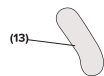
- To fit the cover, start at the outer edges. If necessary, you can use the cover tidier (13) to help you push the cover into the gap.
The plastic parts of the car seat can be cleaned with a mild detergent and warm water.
13. Storage and disposal
Choking hazard! Keep plastic packaging material out of reach of children!
Storage
If you are not using the product for an extended period, please observe the following information:
- Store the product in a safe and dry place.
- Maintain a storage temperature between 20°C and 25°C.
- Do not place heavy objects on the product.
- Do not store the product near heat sources or in direct sunlight.
- Protect the product from moisture, wetness, liquids, dust, and salt spray.
Disposal
- Do not disassemble the product.
- Please observe the disposal regulations in your country.
14. Manufacturer's warranty
MSP - Moin Spatz Products GmbH grants you a 3-year warranty on this product. The warranty is valid in the country where the product was first sold to a consumer. The warranty details and all essential information required to make a warranty claim can be found on our website at: